
The rise of technology in today’s memorial services may not be surprising given the way technological advancements have injected themselves into just about every other facet of our society. But the new features can, nevertheless, be difficult to keep up with as a myriad of new gadgets and services come into being every year. With that in mind – and since statistics say that most people will be involved in the planning of a funeral only two or three times in their lives, at the most – we offer this overview of what technology has begun to offer to the world of funerals and memorial services in recent years. Given the pace at which technology develops, it is likely that many new products and services not mentioned here will be available by the time you are reading this, so, from the out set, we encourage you to discuss this topic of technology in memorial services with a professional such as a funeral director when or if you in the market for planning a memorial service.
Audio technology
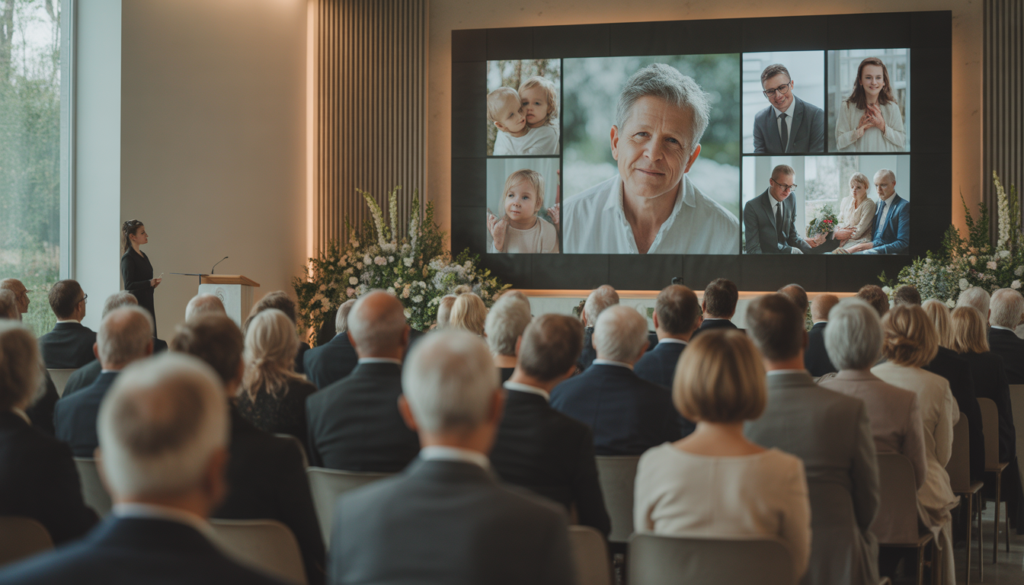
Perhaps the least recognized and appreciated technological innovations in the death care and memorial service industries is audio technology. While many people may be tempted to take these advancements for granted because they are so prevalent in other industries as well, they nevertheless make just about every funeral service conducted today as comfortable as possible. In a nutshell, the latest audio technology – a an easy-to-use mixing board, wireless microphones, and even music playlist scheduling software – are so affordable and easy to use and install that even the smallest funeral home or smallest chapel of a church is outfitted with them today. This means that pre-recorded songs of all types can be played – see our guide to Best Funeral Songs – even without someone there to push a button in many cases – during any funeral, and, further, it means that musicians and speakers will typically have no trouble being heard in just about any hall, and, perhaps most importantly, funeral service audio technology means that just about any funeral can be recorded for posterity. The decision about whether to exercise this option made available by audio technology, of course, is a personal one, and many families in today’s modern society still decide that recordings of such an event are too much, but, nevertheless, the option is available and readily exercised by many appreciative families today.
Video technology
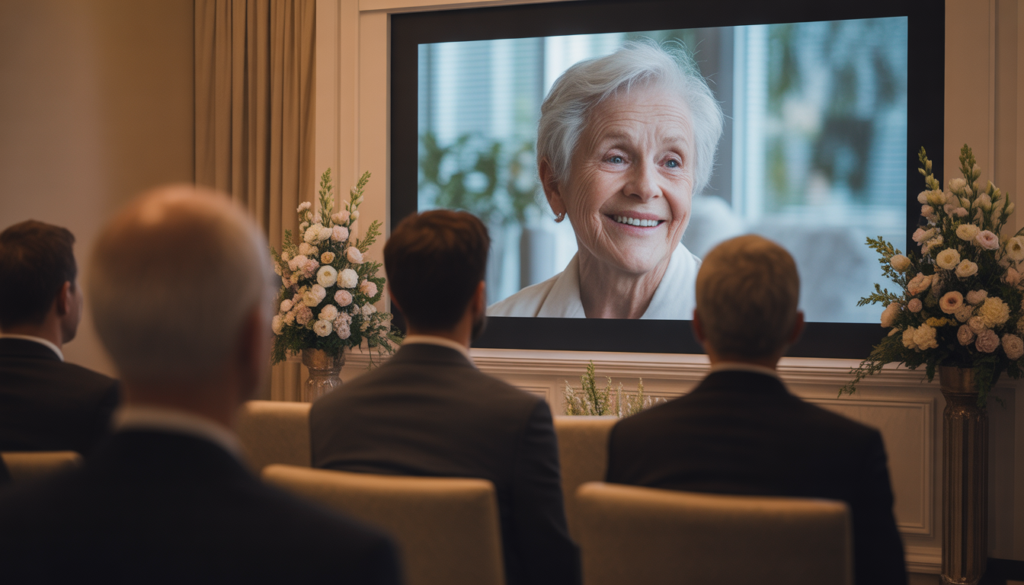
Then we turn to video technology which, likewise, has taken great strides in recent years as video cameras, computer cameras, digital imagine software and many other technological video tools have become – like their audio cousins – easily accessible and affordable for even the smallest of groups and companies. A standard feature of almost every memorial service today is a video presentation of some sort that can play before, during and after a funeral service as visitors and mourners are milling about or perhaps as they are filing before a casket to pay their private respects to the deceased’s body. Many funeral homes today offer this feature automatically as part of their basic set of services and it is the very reason that many families contract the arranging of their funeral services to a funeral home at all. Thanks to advances in video presentation software, assembling photos presented by a family into a fairly sophisticated slide show that can run on a loop for hours at a time is easier than every today – but, since the latest software to build such features easily into a funeral program remains fairly expensive, the service itself can be expensive. Hence many families decide that it is worth the price of hiring a funeral home for services (such as ushering, greeting and even obituary writing ) that a family may otherwise be able (and even inclined) to do itself. Critics of the funeral home business in the United States have said they believe, in many ways, the advent of these expensive pieces of software that make video editing simple and quick – but which are not available inexpensively to the public at large – has been what has saved many funeral homes, especially small ones, from the brink of becoming unprofitable.
But that’s just the start of what video technology has been able to add to funeral services across the United States. Video technology is today employed in the actual service itself in many ways, as lyrics to songs are displayed on screens for entire mourning congregations to sing along with a singer or a choir, and other ceremonial roles, such as who carries the casket at the funeral, are often highlighted for family and friends; many funerals are now simulcast live over the internet via video technology, and, finally video conferencing is even employed commonly in funerals in some regions of the United States where technology’s foothold is strongest. In general, in the funerals that employ video conferencing friends and family from around the world who could not afford (or were just unable for a variety of reasons) to attend a funeral can participate in real time by, perhaps, sharing their thoughts on a large screen before the congregation in much the same way that someone in might if he or she were in person and could simply pick up a microphone to tell a story or two about the deceased. This technological feature of funerals and memorial services has perhaps revolutionized the experience that Americans have at funerals in ways that were, perhaps, unimaginable just 10 years ago.
Online technology
Online technology is, likewise, a common part of nearly every funeral today even if by virtue of the fact that most funeral directors these days communicate quite frequently with their client families by way of email at least in one way or another over the course of their business together. Many a funeral director has written blogs intended to give their colleagues tips and ideas for how to use email to communicate effectively with the families they serve, and, in most of these, the funeral director will, at some point, confess that he or she is not quite sure how he or she got along without email in the days before it was so prevalent.
Aside from the use of email, online technology has changed the way the world thinks about obituaries. These important pieces of information were once the exclusive domain of the large daily newspapers in just about every city across the United States, but, suddenly, newspapers are becoming a secondary publication point for obituaries. Today, if one types in the name of deceased person in just about any search engine he or she is likely to see, at the top of the list, the obituary that is published on the funeral home’s very site itself. And, likewise, that same obituary is often also to be found on the cemetery’s website as well (assuming the cemetery and funeral home are not operated by the same company which has the same website for them both, of course).
The interactive features of this online memorial service technology allow site visitors to post their thoughts and memories about the deceased, and it allows individuals to even respond to those online notes. It is true that many an online memorial site– usually run by a funeral home or cemetery — has become one of the most well-loved and active sites in its particular city. And, with the advent of social media sites like Facebook and Twitter, this trend of memorializing a loved one online is one that is sure to stay. In fact, as cremation becomes more and more of a trend in the United States an as more and more people become socially and economically linked with far flung friends they know solely via the internet – and perhaps never once meet in all of their lives – many an expert in how technology develops have predicted that online memorials may eventually supplant the in-person variety. For the time being, though, online memorials remain simply a part of the bigger picture of just about any memorial ceremony celebrated today – an integral part that few funeral homes dare ignore entirely. But a part, just the same.
Cell phone technology
And the final piece of modern technology that seems to be quickly taking hold in funeral and memorial traditions in increasingly surprising ways is cell phone technology. Perhaps the most important practical use of this technology is in the ability of funeral directors and the families they work with to communicate and organize quickly. What used to take hours – or even days – in the era in which people had to return to their homes to receive phone calls or voice messages (or return to their computers to receive emails), can now take minutes. A family needs to decide on the colors for a funeral spray of flowers? All the florist has to do is send several photos in a quick text message to the family. A “vote” can be done in a matter of minutes, and the selection can be made, simple as that.
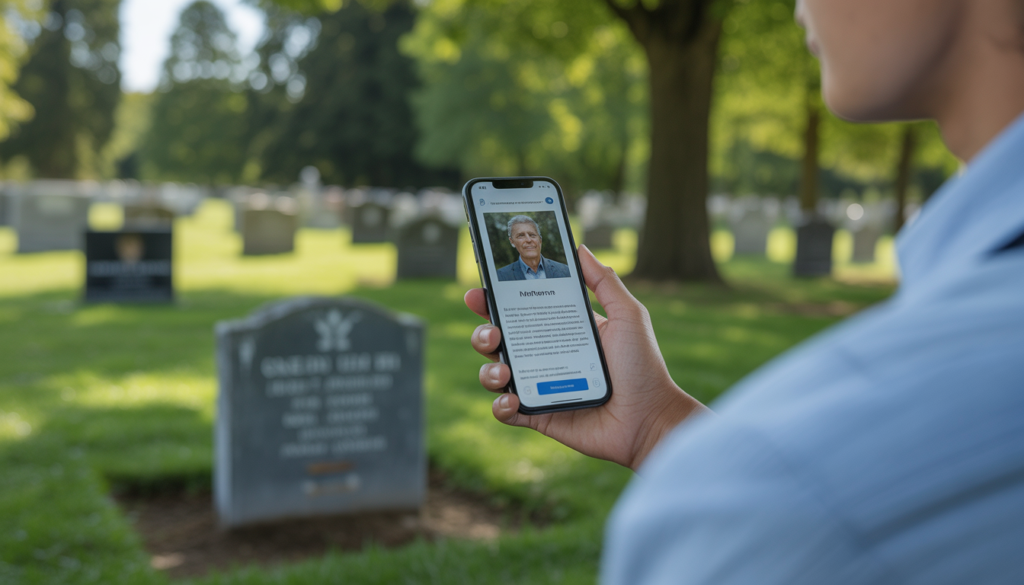
And perhaps the most amazing, and meaningful, use of cell phone technology is in cemeteries these days. Many of the larger properties are set up with cell phone apps that cemeteries can download to hear and see electronic biographies of the deceased. A use would simply type a person’s name into the app, and a video, pictures, or written information about the descendant would quickly appear on the family member’s phone for anyone who happens to be nearby to hear or see as they stand before the very grave.
Like so many other of the memorial technology uses discussed in this article, that last one can help make the experience of losing a loved one a comforting, even uplifting, time.