
Practically everyone as an adult can report that the death of a beloved pet was one painful childhood experience that caused some emotional stress and turmoil. And, even in the case of a pet’s death experienced in adult hood, the trauma can sometimes feel as significant as if a human relative had died. Many scientific studies over the last few decades have confirmed that, since people experience emotional attachment with their pets that is as significant as it is with their human family and friends, the loss of a pet can sometimes feel as significant as well. More than one highly paid, competent professional in a wide variety of fields has reported episodes in which they have surprised themselves and their colleagues with the level of grief they felt when a special cat or dog has pass on. Particularly disturbing for these people are the situations in which they arrive home after a long day at the office only to see their furry friend – who they thought was entirely healthy and happy – lying lifeless in their home. Feelings of guilt begin to become overwhelming, sometimes to the point of complete debilitation for at least a few days. And still others report the emotional turmoil of carrying a sick pet to the veterinarian for what will be a final time. Euthanasia is usually a decision made based on economic principals – a veterinarian suggests that life saving measures could result in thousands of dollars of charges that may prolong a life for just a few months, and the client decides it’s not feasible to proceed. This is perfectly reasonable from a financial and rational point of few, but, the person who must deal with the emotional consequences of making such a “wise” decision to end the life of a friend, has a great number of, perhaps unanticipated, negative feelings to contend in the coming days. Support groups and even psychological specialist abound who can help treat those whose pet had died in these ways – or in any other way, for that matter. But the bottom line is that the loss of a pet that has become thought of as being a member of the family, is painful and distressful. Help accordingly, can seem fleeting (even though the care giver’s efforts may be valiant and well-intended).
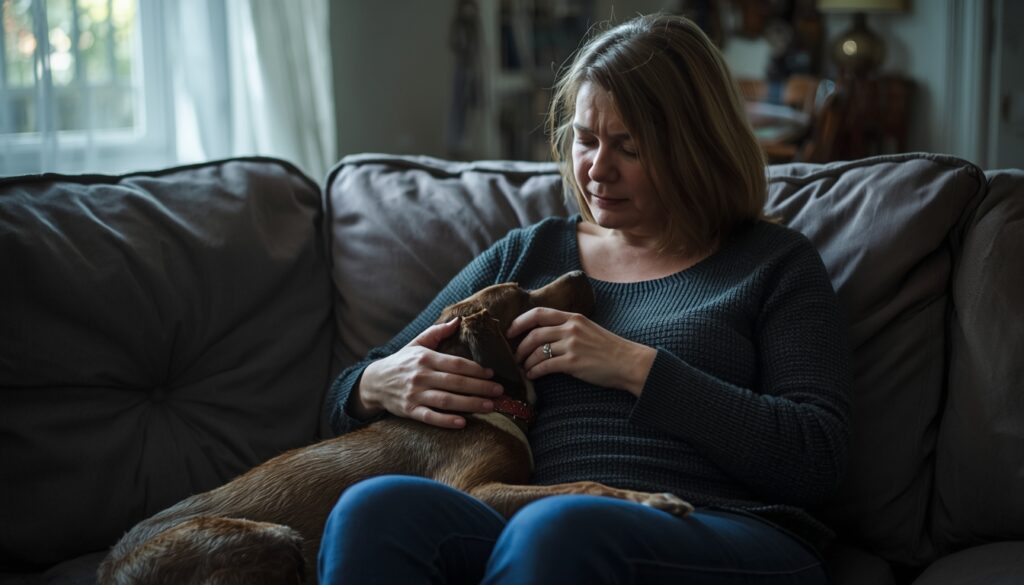
Because this topic has the tendency to create such feelings of isolation and stress for those who are experiencing grief – whether they are children or adults – we have assembled this assortment of facts about grieving over pet loss. We hope the resource will prove valuable and helpful for many families who have lost a beloved friend.
The Stages of Grief
There is much evidence, experts say, that the famous five stages of grief described by Elizabeth Kubler-Ross in her classic book On Death and Dying, are as relevant in the case of pet loss as they are in situations involving the death of a human loved one. To be sure, Kubler-Ross intended her book to be about grief experienced after the loss of a human, but, over the years, psychologists and other experts have studied her model closely and determined that it does indeed apply very well to cases of pet loss.
So, we believe our brief look at pet loss is well suited by beginning with a look at the Kubler-Ross model. They are the following:
Denial: For many, if not most or all, people, the journey through grief begins by denying that the death has occurred. This is an emotional denial, of course, because mentally healthy people have no trouble distinguishing the truth of the matter – that the person or pet who has died is, indeed, truly gone. But accepting that on an emotional level can be very difficult. That is what this first stage encompasses.

Anger: As the reality of a loss begins to finally set in emotionally, a person in the midst of grief often exhibits anger toward those who are only trying to help him or her to cope with a stressful situation.
Bargaining: after anger, even an otherwise rational person may sometimes begin to “negotiate” with a higher power to help ease the pain of grief. Sometimes the negotiating even involves a fantasy that a beloved partner, whether it be a human or a pet, has returned to life somehow.
Depression: when the bargaining of the second stage proves itself irrational, depression can sometimes result. This is the point when many people begin to seriously consider counseling as a means for coping in a healthy manner with their grief.
Acceptance: and, finally, after depression and sadness have run their course – because, actually, they are as irrational as bargaining – then a person has finally advanced to the acceptance stage. Though experts are careful to talk of grief ever being “cured” (because it can truly take a lifetime to cope with and people bounce back and forth between the stages for decades in some cases), this stage is as close to a cure as there is.
Expectations for Others
Often during grief, we expect others to understand our feelings and to respond accordingly. This is why words and actions that are intended to be helpful can sometimes be inadvertently annoying or, worse, they can cause stress on relationships if their intent is misunderstood. This is especially true in cases of grief over pet loss, in which grief is often underestimated by others.
One of the most common examples of this phenomena at work is in situations where friends and family of someone who has lost a beloved dog or cat will suggest a replacement pet too soon after the other has passed away. This sort of thing accidentally sends a message that the griever should “get over” the loss of a pet, that the grieving is disturbing to others.
Clearly, this message comes from a simple ignorance at how grief over pet loss works. One would never suggest, for example, that a woman whose son has died in a car wreck begin immediately to look for another son to adopt within a few weeks of the funeral. Right?
Well, for many people, the pain of losing a pet is emotionally identical – if not quite as emotionally intense – as losing a relative. And, our important point in this case is this:
Rather than be resentful of those who do not understand this about grief over the loss of a pet, one who is suffering the grief is best suited in adopting an approach of forgiveness. By understanding the many facets of grief – and how it works in cases of pet loss- a person who is suffering can see how it is affecting his or her own feelings and behaviors and can modify them in the event that someone says something that could be construed as insensitive. In such cases, the mourner will find himself or herself able to calmly explain the emotions to a friend who has erred, and this will lead to much more healthy supportive communication from the friend.
We can sum up this section of this article by saying, it is important for someone who has lost a pet to adjust their own expectations of their friends and family so that they do not become disappointed and disillusioned when people accidentally “say the wrong thing” that works against the healing of their grief. Forgiveness – and even a little education – is always good.
Memorial Products That Can Help
Anyone who is suffering grief from the loss of a pet may find it helpful to learn that there is an entire industry devoted to supporting those who are experiencing this emotional pain. Pet memorial products are available today in a huge variety of styles and prices, and their helpfulness should not be underestimated. For more inspiration on meaningful ways to honor a beloved companion, see Creating Pet Memorial Ideas.
Among the beautiful products that a person can order at any time to be shipped to his or her doorstep within a few days are pet cremation urns, pet headstones, and pet cremation jewelry. (There are many other products such as caskets and other memorabilia, but this article will stop at the first three. Any website that sells those products will also, generally speaking, sell the others.)
Pet cremation urns are available in a wide selection, and you will certainly be able to find one that suits your memories of your beloved friend quite well. Many can be personalized to include a brief epitaph along with the name and dates of the pet’s life. Some can even be personalized further with a photograph of the pet included as part of the urn.

Pet headstones, likewise, are available in many styles, colors and prices. They can be fitted to suit the requirements of a formal “pet cemetery,” or they can be designed for a back yard grave of a beloved, faithful friend.
And, finally, pet cremation jewelry is a surprising part of the pet memorial industry that many who are grieving over the loss of a pet will find helpful. With these pieces, a pet owner can fill a small compartment in the pendant or bracelet with a trace amount of the animal’s remains. And the memory of the beloved friend will stay with the owner for as long as he or she desires.
This article is just the start of ideas for how best to cope with the loss of an animal friend that has been a great pleasure to one’s life. For more ideas, just about any search engine can lead to plenty of help.