
Undertakers are also in today’s world as funeral directors, and, though many experts object, funeral directors are, increasingly becoming known as grief counselors too. In order to help reshape their image and insure viability of their entire industry, funeral directors and others in the death care business began in about the 1970’s to add grief counseling services to their repertoire of offerings. And many critics of the industry – such as the legendary (or, to hear many funeral directors describe her, “infamous”) journalist Jessica Mittford whose famous work “American Way of Death,” first published in the 1960’s resulted in several legal reforms in the industry – say they smelled a rat right from the start. Grief counseling is just a great way to get close to potential customers in order to sell them products and services they might not otherwise buy, Mittford (and others) warned. And still today, psychological experts, journalists, and even some unpopular (among their peers, at least) funeral directors and death care industry managers have little trouble being outspoken on the idea that undertakers typically are not the best choice for grief counseling services after the loss of a loved one. The ethics of funeral homes becoming the counseling confidants of those to whom they hope to sell funeral planning and burial good services is a hot topic on blogs maintained by people who work in the funeral home industry and in funeral service trade publications as well as even in publications that focus on general interest news and those that specialize in mental health matters. Those who are employed in mental health fields tend to question the practice on very serious grounds and some in the funeral home profession agree with them wholeheartedly. But still others in the death care industry defend their practice as vital to marketing efforts aimed at giving families grieving over the loss of a loved one exactly what they need for good emotional healing, and, further, free speech advocates argue that it is dangerous for democracy to suggest that only those who are licensed and trained in a particular field may offer advice to those who seek it. These advocates point out that, so long as funeral directors and others involved with death care in the United States do not offer their counseling services for a fee – but, rather, offer them as a complimentary service aimed at helping families to cope with their loss – there is no room for discussions of questionable ethics.
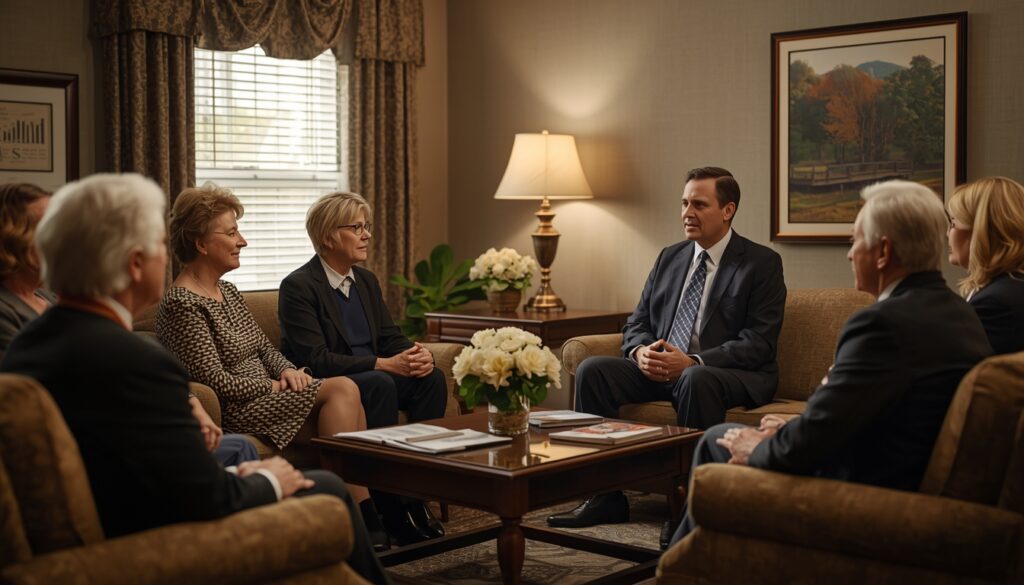
Because this topic can have great emotional and financial consequences for those who have lost a loved one and turn to a funeral director and the overall staff of a funeral home for assistance in any number of important problems, we offer the following summary of the background discussion on this issue.
How Funeral Homes Package Their Grief Counseling Services
The first thing that clients, or potential clients, of funeral homes should know about grief counseling services available from an undertaker or funeral director are never (or at least almost never) marketed as professional counseling services. Rather, they are typically advertised as community services that offer informal, non-professional “support” for those who have lost a loved one. Often the funeral homes team up with churches or other similar groups – sometimes even government agencies – to provide and market these services. Typically, the services are given some name such as “after care” or “grief support” and they may even be advertised in newspaper and broadcast public service announcements or community calendar listings. (Critics see this as a ploy for the funeral home to get free advertising.) The services are often appealing to members of the public because they are typically free of charge and open to anyone who cares to attend. Usually members of the public are even able to attend the meetings and other presentations anonymously, though those who attend can expect that they will receive sales literature from the funeral home or cemetery that is hosting or sponsoring the meeting. At the meetings arranged by these services, a funeral director or other funeral home staff may facilitate the discussion, but he or she will likely be very careful to not offer specific psychological advise for anyone who may be seeking such help in relation to their grieving. It is true that some people who attend grief counseling sessions organized and hosted by funeral homes or funeral directors will sometimes benefit from being referred to professional counselors or psychologists who can address their unique situation much more appropriately than is possible in a funeral home’s meeting. While it is true that funeral directors in most states do receive some formal instruction on grief counseling as part of their licensing requirements (or as part of their requirements for renewing a license), this training should not be considered a suitable replacement for trained psychological or psychiatric advice and, in fact, part of the training typically will be devoted to what exactly is legally beyond the scope of funeral directors’ grief counseling. Typically speaking, the grief counseling provided by a funeral home will focus on encouraging participants to be open and honest with others about their feelings of grief and being very aware of the famous “5 stages of grief” that mental health experts typically discuss much more thoroughly with their clients.
Purposes of Grief Counseling
Ostensibly the purpose of grief counseling provided by a funeral home, cemetery or even an individual funeral director is to give families the support they need to cope successfully with the difficult loss of a loved one. And, while critics will argue that there are many other, less nobel, motives, it is hard to deny that, for many people, the services can be extraordinarily useful. In general, the counseling takes the form of meetings – often weekly, and often even divided into various classes so that people with similar experiences can connect with one another. Children who have lost parents may attend one group, while adults who have lost parents or perhaps a sibling may attend a different meeting. – in which participants are encouraged to talk about their feelings and connect with one another so as to offer emotional support. In many cases, the members are encouraged to trade phone numbers and other contact information and to get together socially for coffee, game nights and other such activities. Such programs tend to be helpful for at least some of a funeral home’s clients because they help foster a sense of community among those who have recently lost a loved one, and they can help people who may otherwise feel lost in a sea of despair or loneliness to feel a sense of fellowship and even hopefulness that is so important to their ultimate emotional healing.

But, as we say, all that is the ostensible purpose of grief counseling as provided by a funeral home.
The more cynical view of the purpose of these services takes note that the tradition of funeral homes providing grief counseling began to take hold mostly during the 1970’s when funeral homes across the United States were in a major transition period, threatened by the popularity of cremation which was bringing “traditional” funerals under attack. Without a body to present in an elaborate manner in a sophisticated looking casket, funerals for those who had been cremated were becoming much more simple, even informal, and that meant that much of what funeral homes had been doing for a livelihood in previous decades was seeing itself in less and less of a demand. Funeral homes, therefore, needed a gimmick to get even families of those whose bodies were to be cremated and disposed of very simply into their doors. Grief counseling was just that trick.
By tying traditional funeral services in to the idea of healthy grieving, funeral homes were able to salvage a great deal of their business, using the marketing benefits provided by their grief counseling programs to make the case that ornate, elaborate funerals – such as those that funeral homes had become in the habit of organizing – were an important part of the grieving process and that any thought of forgoing such luxuries could carry potential emotional consequences, highlighting why memorials are important for families. Many families also naturally wonder how long it takes to plan a funeral. Funeral directors were, and continue to be, careful to never make this argument directly. But the use of grief counseling in a funeral home’s “community service” initiatives is a clear use of marketing position theory as taught in public relations and advertising classrooms across the United States. It cleverly ties (positions) the idea of grief healing to that of an elaborate, expensive funeral (even for someone who has been or will be cremated) and subtlety presents the argument that a “traditional” funeral is all but necessary for healthy management of grief. This argument is not necessarily supported by scientific evidence, however, but many funeral home clients are happy to provide enough up-beat anecdotal evidence for use in marketing materials to help keep the tradition of funeral home grief counseling still going strong today.
Effectiveness of Grief Counseling
As we say, science has not seen fit yet to declare that grief counseling, as it is practiced in a funeral home (in other words, where the focus is, albiet subtlety in most cases, on providing the deceased an elaborate, stylish and expensive memorial ceremony) is an effective means of helping grief stricken relatives to cope effectively with their emotions. The book is still out on that, in fact.
In the meantime, it is also debatable whether the programs provided by funeral homes are effective in the ulterior aims of helping make the case for expensive funerals. Every year many would-be customers of funeral homes find themselves forgoing expensive memorial services complete with expensive hearses (nowadays known as coaches) and elaborately designed coffins (almost always called caskets in today’s world) and instead “just throwing a party.” In fact, that is sometimes the very first request made of a deceased on his or her last will and testament: “Don’t use a funeral home’s services for me. Just cremate me and then throw a party.” Many families who choose cremation also select keepsakes such as cremation urns or cremation jewelry to honor their loved ones in a personal way.
It is true that funeral homes have managed to keep their costly, dignified services in the market even in cases of cremation, but it is debatable that grief counseling programs are the reason. That discussion may end up being best had by scholars in the academic world of marketing, however, as those who run and manage funeral homes seemed to remain fairly committed to their grief counseling services despite the solid evidence of their effectiveness. So long as funeral homes continue to be profitable – and a look at any day’s stock market report featuring the financial figures of the publicly traded death care companies definitely shows that the industry is as profitable as the business world has to offer – it seems unlikely that significant movement will be made away from grief counseling as a marketing strategy.

But, that said, there are some rumblings in the world of bloggers who write about the funeral home business. A small-but-growing number of insiders in the business use their blogs to occasionally opine that customers may be becoming wise to the marketing tricks behind grief counseling offered by funeral homes. And that may, ultimately, begin to work against the industry if it does not start dismantling the tradition. Some of these men and women encourage their colleagues to simply stick to what their industry has always done, organize memorial celebrations, and let a well-organized funeral do the grief counseling on its own, the way it did for decades before grief counseling became a formal service of the funeral director trade. “Healthy grieving does, indeed, stem from a good funeral. But our job is just to bring about the funeral, not try to bring about the grieving too. The later is overkill, and our customers don’t really want or need that from us,” one funeral director said on a recent blog article – which was not universally well received by commenters writing beneath his post.